Motor Accident Claim in Hisar: MACT Process, Documents, Compensation & Timeline
Complete legal guide to filing a motor accident claim in Hisar MACT court. Learn documentation, calculation of compensation, timelines, and legal process. Slug: motor-accident-claim-hisar

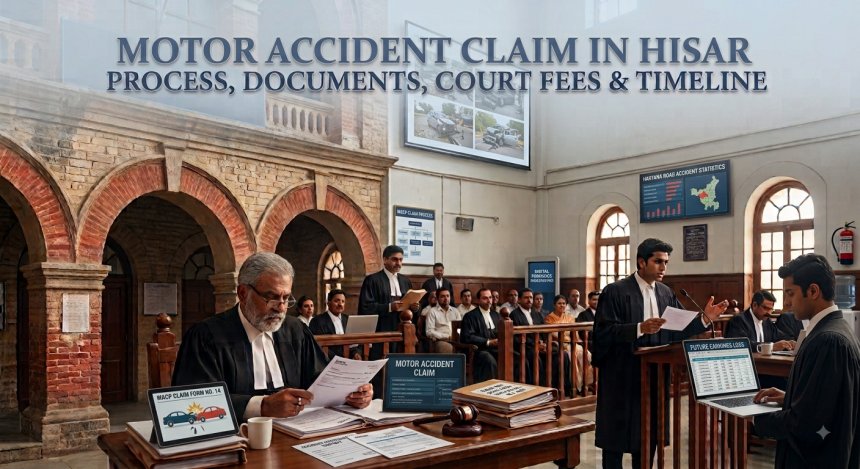
Motor Accident Claim in Hisar: MACT Process, Documents, Compensation & Timeline
A road traffic accident on the national highways crossing Hisar—such as NH-9 (Hisar-Delhi/Sirsa bypass) or NH-52 (Hisar-Chandigarh route)—or within busy city intersections like Parijat Chowk, Dabra Chowk, or the Cantonment area, can disrupt a family's financial and emotional stability in seconds. When severe injury, permanent disability, or an untimely death occurs, the victims and their legal dependents are legally entitled to monetary compensation under Indian law.Motor Accident Claim in Hisar: MACT Process, Documents, Compensation & Timeline
However, navigating the Motor Accident Claims Tribunal (MACT) in Hisar requires an understanding of strict statutory deadlines, procedural rules, police documentation, and evidence collection. Many claimants lose substantial compensation simply because they settle too early out of court, fail to gather mandatory documents, or miss statutory limitation windows.
Understanding the Problem: Ground Realities in Road Accident Claims
When an accident takes place, families are primarily focused on emergency medical treatment at local hospitals like Civil Hospital Hisar, Maharaja Agrasen Civil Hospital, or private trauma centers. In this critical period, vital legal procedures are frequently overlooked.
Common Scenarios Encountered in Hisar
-
Severe Commercial Vehicle Collisions: Accidents involving over-speeding trucks, tractor-trolleys carrying agricultural produce on rural link roads (e.g., Balsamand, Barwala, or Hansi routes), or interstate buses.
-
Two-Wheeler Injuries: Two-wheeler riders hit by rashly driven private cars or commercial delivery vehicles.
-
Hit-and-Run Incidents: Accidents where the offending vehicle flees without leaving registration details.
-
Fatalities of the Sole Breadwinner: Leaving minor children, dependent spouses, and elderly parents without financial support.
Practical Pitfalls
-
Delay in Reporting: Not registering an FIR immediately or accepting an oral compromise at the police post (Chowki) without realizing the long-term cost of medical treatment.
-
Accepting Informal Cash Settlements: Accepting a small amount from the offending driver to cover immediate emergency room bills while giving up claims worth lakhs or crores of rupees against the insurance company.
-
Overlooking Detailed Accident Reports (DAR): Relying solely on the police without following up on the statutory timeline to submit the Detailed Accident Report to the MACT.
What Does Indian Law Say?
Motor accident compensation is governed under special socio-welfare statutory provisions designed to indemnify victims against negligent driving.
-
Motor Vehicles Act, 1988 (as amended by the Motor Vehicles Amendment Act, 2019):
-
Section 166 (Application for Compensation): Enables victims or legal heirs to file a fault-based claim against the driver, owner, and insurer where rash and negligent driving is established.
-
Section 164 (No-Fault Liability): Prescribes statutory fixed compensation (e.g., ₹5,00,000 in case of death and ₹2,50,000 for grievous hurt) without needing to prove negligence.
-
Section 166(3) (Limitation Period): Imposes a strict 6-month limitation period from the date of the accident to file an application for compensation before the Claims Tribunal.
-
-
Bharatiya Nagarik Suraksha Sanhita, 2023 (BNSS) & Bharatiya Nyaya Sanhita, 2023 (BNS):
-
Criminal proceedings for rash driving, causing grievous hurt by negligence, or causing death by negligence (formerly Sections 279, 337, 338, and 304A IPC) run concurrently with the civil MACT claim. The FIR, site plan, and final police report (Challan) under BNSS serve as primary evidence in MACT.
-
-
Bharatiya Sakshya Adhiniyam, 2023 (BSA):
-
Dictates the admissibility of digital evidence (CCTV footage, dashcam recordings, hospital electronic records, and mechanical inspection certifications).
-
-
Binding Precedents of the Supreme Court of India:
-
Sarla Verma v. DTC (2009) & National Insurance Co. Ltd. v. Pranay Sethi (2017): Set the standardized formula for calculating multipliers, deduction for personal living expenses, loss of estate, loss of consortium, and future prospects.
-
Step-by-Step Legal Process at MACT Hisar
Step 1: Emergency & FIR ➔ Step 2: DAR Investigation ➔ Step 3: Filing Claim Petition ➔ Step 4: Written Statement & Issues ➔ Step 5: Evidence & Arguments ➔ Step 6: Award & Execution
Step 1: FIR Registration and Criminal Investigation
Immediately report the accident to the jurisdictional police station (e.g., Urban Estate, Civil Lines, Sadar Hisar, or City Hisar). An FIR must be lodged capturing the offending vehicle's make, model, registration number, and the names of eyewitnesses.
Step 2: Detailed Accident Report (DAR) Submission
Under the amended Motor Vehicle Rules, the Investigating Officer (IO) is mandated to verify the driver’s license, insurance policy, and vehicle fitness, compiling this into a Detailed Accident Report (DAR/FAR) and submitting it to the MACT within the prescribed statutory timeframe.
Step 3: Drafting and Filing the Claim Petition
The victim or legal heirs file a petition under Section 166 (or Section 164) before the Motor Accident Claims Tribunal at the District Courts Complex, Hisar. Jurisdiction lies where:
-
The accident occurred, OR
-
The claimant resides or carries on business, OR
-
The defendant/insurer resides or operates.
Step 4: Notice and Written Statement
The Tribunal issues summons to the driver, registered owner, and the insurance company. The insurance company files its Written Statement (defense), often contesting the driver's license validity, permit violations, or raising allegations of contributory negligence.
Step 5: Framing of Issues and Evidence Stage
The Court frames issues regarding:
-
Whether the accident was caused by the rash and negligent driving of the offending vehicle.
-
The entitlement and quantum of compensation.
The claimant leads primary evidence: witness testimonies, medical board disability certificates, income tax returns (ITRs), and salary slips.
Step 6: Final Arguments and the Award
Both advocates argue on the assessment of income, dependency multiplier, future prospects, and non-pecuniary heads (pain and suffering, loss of consortium, funeral expenses). The Tribunal then passes a detailed Award directing the insurance company (or owner/driver) to pay compensation with interest (typically 6% to 9% per annum from the date of filing).
Step 7: Deposit and Execution
The insurer is given 30 to 90 days to deposit the awarded compensation into the Tribunal’s designated bank account, which is disbursed directly into the claimant's bank accounts via MACAD (Motor Accident Claims Annuity Deposit) accounts.
Documents Required for an MACT Claim
| Document Category | Document Name | Purpose & Legal Significance |
| Mandatory | First Information Report (FIR) | Proves the occurrence of the incident, vehicle involvement, and initial facts. |
| Mandatory | Certified Copy of Final Police Report (Challan) | Confirms that police investigation found the offending driver culpable. |
| Mandatory | Site Plan (Naksha Mauka) | Demonstrates the point of impact, road width, and skid marks to counter contributory negligence. |
| Mandatory | Post-Mortem Report / MLC | Medico-Legal Case (MLC) proves nature of injuries; Post-Mortem proves cause of death. |
| Mandatory | Vehicle Mechanical Inspection Report | Disproves claims that mechanical failure (e.g., brake failure) caused the collision. |
| Mandatory | Identity & Legal Heir Proofs | Aadhaar cards, Voter IDs, Parivar Pehchan Patra (PPP), and surviving member certificates. |
| Mandatory (Disability) | Permanent Disability Certificate | Issued by a government CMO/Medical Board quantifying whole-body physical disability. |
| Mandatory (Income) | Income Proofs (ITR, Salary Slips, Form 16) | Sets the baseline monthly/annual earning capacity of the deceased or injured victim. |
| Supporting | Original Medical Bills & Discharge Summaries | Claims actual medical expenditures, surgeries, medicines, and prosthetic costs. |
| Supporting | Registration Certificate (RC) & Insurance Copy | Confirms insurance coverage of all vehicles involved. |
| Optional | CCTV / Dashcam Footage | High-value electronic evidence under BSA to establish rash driving directly. |
Expected Timeline and Process Duration
-
Standard MACT Adjudication: 12 to 24 months from the date of filing to the final award in contested cases.
-
Summary Settlement via Lok Adalat: If liability is undisputed and the insurer is open to an amicable settlement, claims can be resolved within 3 to 6 months during National or State Lok Adalats held at the District Courts Complex, Hisar.
-
Appeals: Either party may appeal the MACT award before the Punjab and Haryana High Court at Chandigarh within 90 days. High Court appeals typically take an additional 1 to 3 years depending on the roster.
Breakdown of Costs & Legal Fees
Note on Fees: Legal fees vary depending on the complexity of the matter, the court involved, the level of evidence required, documentation volume, and the advocate’s experience.
-
Court Fees: Nominal in Haryana for MACT claim petitions, often governed by a fixed nominal slab or indexed according to state court fee amendments, making MACT access affordable for grieving families.
-
Process and Summons Fees: Modest clerical costs associated with issuing summons, notices, and obtaining certified court orders.
-
Medical Board Examination Charges: Official government hospital fees for constituting a medical board to obtain a certified disability assessment.
-
Drafting and Professional Representation Fees: Covers drafting the petition, handling cross-examinations of insurance investigators, examining medical experts, and making legal arguments based on Supreme Court formulas.
Practical Realities & Hidden Facts
-
The 6-Month Rule is Strict: Following the 2019 amendments to the Motor Vehicles Act, Section 166(3) introduced a 6-month limitation period from the date of the accident. Filing after this statutory window can lead to immediate dismissal unless filed under exceptional statutory remedies.
-
The "Minimum Wage" Trap: If the claimant fails to produce authentic ITRs, bank statements, or salary certificates, the Court will assess income on the basis of the notified minimum wages for skilled/unskilled labor in Haryana for that specific year, significantly lowering the total award.
-
Contributory Negligence Allegations: Insurance companies frequently argue that the victim was not wearing a helmet, was overloaded on a two-wheeler, or was speeding, aiming to cut the final payout by 20% to 50%.
-
Driver's License & Policy Breaches: If the offending driver held a fake license or lacked an active commercial permit, the insurance company will argue for total exoneration. However, under the principle of "Pay and Recover", the Court often directs the insurer to pay the victim first and recover the sum from the vehicle owner later.
Common Mistakes to Avoid
-
Failing to note vehicle details: Not noting the complete registration number or photographing the accident spot immediately.
-
Delayed medical examination: Delaying an MLC examination at the civil hospital, allowing the defense to argue injuries occurred elsewhere.
-
Losing medical bills: Failing to retain every pharmacy receipt, diagnostic scan bill, and hospital invoice.
-
Accepting early insurance surveyor offers: Signing full-and-final settlement vouchers directly with insurance adjusters without legal consultation.
-
Ignoring future prospects: Forgetting to claim the mandatory 10% to 50% future prospect income additions guaranteed under the Pranay Sethi judgment.
-
Incomplete array of parties: Omitting the registered owner, driver, or insurance company from the memo of parties.
-
Not examining the treating doctor: Failing to summon the treating doctor or CMO to prove the percentage of whole-body functional disability.
-
Compromising the criminal case prematurely: Signing compromise deeds with the driver in the criminal case, which the insurance company then uses to dismiss negligence in MACT.
-
Ignoring non-pecuniary damages: Not claiming amounts for loss of consortium (spousal, parental, and filial), loss of estate, and funeral expenses.
-
Missing the 6-month filing deadline: Waiting beyond 6 months to start the claim process.
When Should You Hire an Advocate?
Retaining an advocate experienced in MACT proceedings at the District Courts Hisar is essential when:
-
The accident resulted in fatal injuries or permanent functional disability.
-
The insurance company denies liability citing policy breach, lack of route permit, or an invalid driver's license.
-
The deceased was a business owner, professional, or salaried individual whose actual income must be established using audited financial records.
-
The matter involves multiple vehicles or allegations of contributory negligence.
-
The claimant needs representation during Lok Adalat negotiations to ensure the settlement accurately reflects statutory compensation formulas.
Frequently Asked Questions
1. Where is the MACT court located in Hisar?
The Motor Accident Claims Tribunal sits within the District and Sessions Courts Complex, Hisar, Haryana.
2. Can I claim compensation if the accident was partly my fault?
Yes. Under the principle of contributory negligence, the tribunal reduces the total compensation in proportion to your share of fault rather than dismissing the claim outright.
3. What happens if the offending vehicle did not have insurance?
The claim remains valid. The MACT will pass an award directly against the driver and the registered owner of the offending vehicle, executable against their personal assets and properties.
4. How is compensation calculated in death cases?
Compensation is calculated by taking the deceased's annual income, adding future prospects (10% to 50% based on age/employment), deducting personal expenses (1/2 to 1/5 based on family size), applying the standard age multiplier, and adding conventional heads (consortium, funeral costs, loss of estate).
5. Can housewives or non-earning family members get compensation?
Yes. The Supreme Court recognizes the valuable economic contribution of homemakers, assigning a structured notional income for computing fair compensation.
6. Can I file the claim in Hisar if the accident happened in another district?
Yes. You can file the claim petition before the MACT in Hisar if you reside in Hisar, if the defendants operate in Hisar, or if the accident took place within Hisar district boundaries.
7. What is the compensation for Hit-and-Run cases?
Under Section 161 of the amended Motor Vehicles Act, compensation for death in a hit-and-run accident is fixed at ₹2,00,000, and grievous injury at ₹50,000, funded via the Solatium Scheme managed by the government.
8. Is the compensation awarded by MACT taxable?
Interest earned on motor accident claims compensation is subject to specific TDS exemptions and provisions under Section 194A of the Income Tax Act up to prescribed limits; the core compensation amount is generally exempt as a capital receipt.
9. Can minor children file an MACT claim?
Yes. Minor children can file a claim petition through their natural guardian or next friend (such as a surviving parent, relative, or appointed legal guardian).
10. Can we appeal if the compensation amount awarded by MACT Hisar is too low?
Yes. An appeal for enhancement of compensation can be filed before the Punjab and Haryana High Court at Chandigarh within 90 days of the MACT award.